
Pests
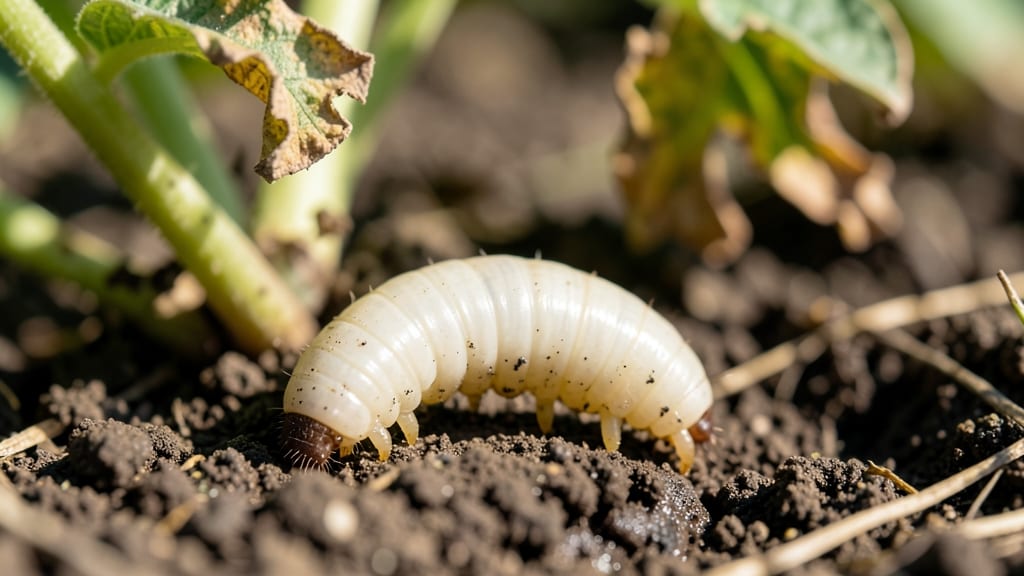
Grub worms are absolutely bad for your garden since they devour grass roots and plant roots, creating unsightly brown patches, wilting foliage, and structurally weak lawns. Their larval stage is particularly devastating to turf and young plants.
Grub worms thrive underground, turning your lawn into a buffet of roots. 🌱 Their feeding habits don't just weaken plants—they create perfect conditions for soil compaction, which stunts root growth and makes recovery nearly impossible.
I've seen entire lawn sections die back after just one season of heavy infestation, especially in drought-prone areas where roots already struggle.
What makes them so destructive is their lifecycle. These beetle larvae spend months underground, systematically stripping away root systems before pupating into adult beetles.
The damage often goes unnoticed until it's too late, as symptoms like spongy turf or plants that pull easily from the soil appear only after significant root loss has occurred.
💡 In This Article
- How Grub Worms Damage Garden Plants and Lawns
- Natural and Chemical Solutions to Control Grub Worms
How grub worms damage garden plants and lawns
Grub worms, the larvae of scarab beetles like Japanese beetles or European chafer beetles, start their damage cycle when female beetles lay eggs in soil during late summer.
These eggs hatch into tiny white grubs measuring just 1/8-inch long, but within weeks, they grow to 1-1.5 inches—the size of your pinky finger—while voraciously consuming grass roots and plant roots.
Their feeding creates a network of tunnels that disrupts water and nutrient flow, similar to how termites weaken wooden structures.
The real devastation happens during their 3-5 month larval stage, when they can consume up to 50 pounds of roots per 1,000 square feet of lawn.
This root loss creates classic symptoms like spongy turf that feels springy underfoot, thin patches where grass fails to regrow, and wilted plants that pull easily from the soil.
In severe cases, entire lawn sections die back, leaving behind brown, dry areas that resemble drought damage—even when moisture levels are normal. 🌱
Their feeding habits also compact soil by creating tunnels that collapse, reducing pore space by up to 30%. This compaction restricts root growth and water infiltration, making recovery difficult even after the grubs are gone.
Young seedlings and shallow-rooted plants like lettuce or carrots are particularly vulnerable, as their delicate root systems can't compensate for the sudden loss of structural support.
What makes grub worms so insidious is their ability to go undetected until the damage is severe. Unlike surface pests, they operate below ground, and their feeding patterns often mimic other lawn problems like fungal infections or nutrient deficiencies.
By the time you notice the symptoms—like grass that peels back easily or plants that topple over—a single grub can have already consumed 0.5-1 gram of roots daily, equivalent to the weight of a nickel.
Seasonal timing matters too. Grubs are most active during spring and fall, when soil temperatures are ideal (between 60-80°F). In these conditions, they can multiply rapidly, with a single female beetle capable of producing 40-60 eggs that all hatch into root-munching larvae.
This exponential growth explains why infestations often spiral out of control within a single growing season.
Consider this comparison: A healthy lawn has 10-15 pounds of roots per 1,000 square feet. Grub worms can reduce this by 70-80% during peak feeding periods, leaving plants starved for stability and nutrients.
The result? A lawn that looks healthy on top but is essentially root-bound and dying from within. 🌿
To make matters worse, their presence creates perfect conditions for other pests. The weakened turf becomes more susceptible to diseases like brown patch fungus, and the compacted soil attracts other burrowing insects like cutworms. This creates a vicious cycle where one problem compounds another, making recovery even more challenging.