
Tools
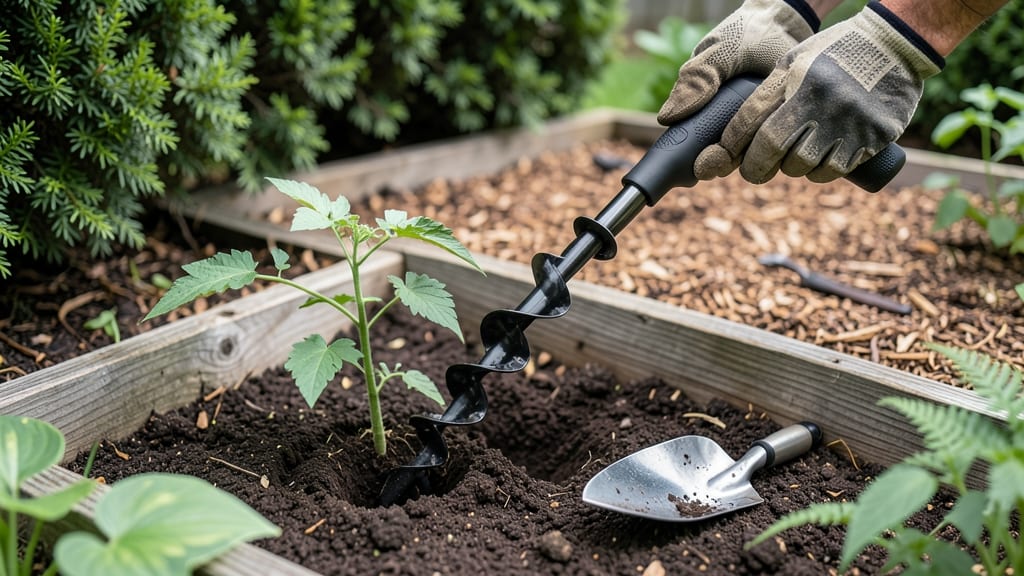
For garden tasks, selecting the right auger means pairing its size, power source, and blade design with your soil type and project needs—whether you're planting trees, installing irrigation, or aerating lawns. Options range from manual augers for light work to electric or gas-powered models for heavy-duty digging.
A garden auger's effectiveness depends on three key factors: its power source (manual, electric, or gas), depth capacity, and blade type. Manual augers are perfect for small-scale tasks like planting shrubs or creating drainage holes, while electric models offer consistent torque for larger projects.
Gas-powered augers dominate for heavy-duty work like tree planting or deep irrigation wells. The right choice prevents unnecessary strain and maximizes efficiency. 🔥
For example, a spiral auger works best for loose soil, while a post-hole auger handles rocky terrain. I always recommend testing your soil first—hard clay demands more power than sandy loam. The blade design directly impacts how cleanly the auger cuts through soil, reducing the effort needed for deep holes.
Budget is another critical factor: manual augers start around $20, while professional-grade gas models can exceed $500. Investing in a quality auger pays off when you're tackling large-scale landscaping projects or need to drill multiple deep holes without fatigue.
💡 In This Article
- Types of Garden Augers and Their Best Uses
- Key Features to Compare Before Buying a Garden Auger
Types of garden augers and their best uses
The core difference between garden augers lies in their power source and blade design, both of which determine how they interact with soil. Manual augers rely on pure physical leverage, making them ideal for small-scale tasks like planting shrubs or creating shallow drainage holes.
Their spiral blades (typically 3-6 inches wide) cut through loose soil with minimal resistance, but they struggle with compacted clay or rocky terrain. Electric augers, on the other hand, deliver consistent torque—often 100-300 foot-pounds—perfect for medium-depth projects like installing irrigation lines or planting small trees.
Gas-powered augers dominate heavy-duty work thanks to their high torque (up to 1,000 foot-pounds) and ability to handle 24-36 inch depths effortlessly.
The blade design varies significantly: post-hole augers feature sharp, serrated edges for breaking through roots and rocks, while soil-screwing augers have helical flights that pull soil upward as they drill. This upward ejection prevents clogging—a common issue with manual augers in wet soil.
For example, a post-hole auger with a 12-inch cutting diameter can bore through hardpan in minutes, whereas a manual auger would require hours of backbreaking effort.
Your soil type dictates which auger performs best. Sandy loam responds well to all types, but clay demands electric or gas power to avoid blade slippage.
The key mechanism here is how augers convert rotational force into cutting action: electric models use gears to maintain steady RPMs, while gas models rely on engine speed for variable torque.
This variability is crucial for tasks like drilling deep irrigation wells, where you need to adjust speed based on soil resistance. I’ve seen gardeners struggle with manual augers in clay because the blades simply can’t generate enough downward pressure to penetrate.
Blade material also plays a role—high-carbon steel resists wear in rocky soil, while aluminum blades are lighter but less durable.
For instance, a soil-screwing auger with a 14-inch spiral blade excels at aerating lawns because it pulls up soil cores cleanly, while a post-hole auger’s aggressive teeth are designed to shear through roots. The trade-off?
Post-hole augers leave rougher hole edges, which is fine for planting but problematic for precision irrigation work.
Consider this scenario: Planting a 10-foot deep irrigation well in rocky soil. A manual auger would take days and leave inconsistent holes, while a gas-powered post-hole auger with a 14-inch cutting diameter would handle it in under an hour.
The right tool doesn’t just save time—it transforms a laborious chore into a manageable task. 💫
For budget-conscious gardeners, electric augers offer a middle ground. They’re quieter than gas models and require less maintenance, making them perfect for suburban yards where noise and emissions matter. However, they lack the raw power for extreme conditions, like frozen ground or dense clay.
Always match the auger’s capabilities to your project’s demands—skipping this step often leads to frustration and wasted effort.