
Pests
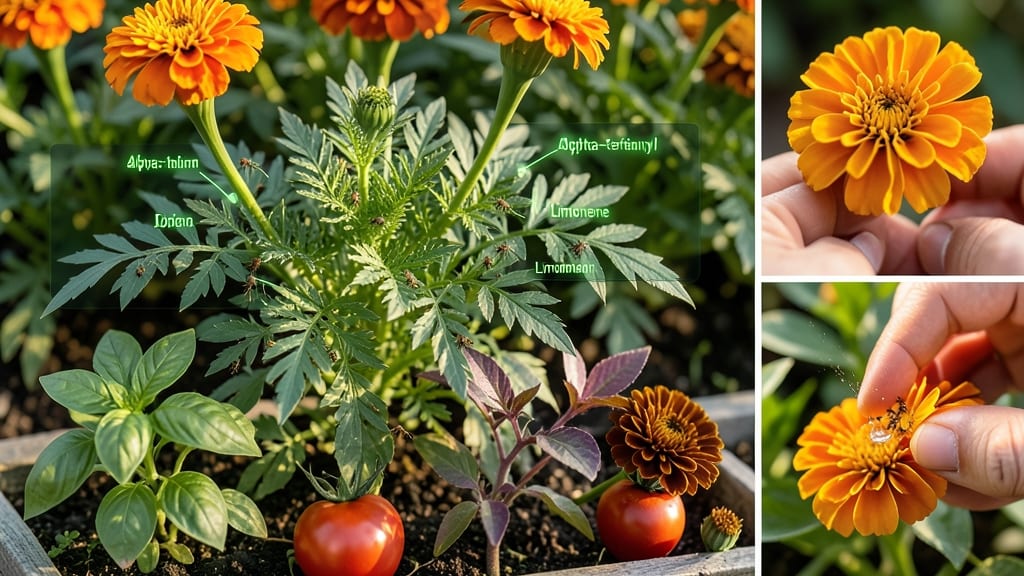
Using marigolds for garden pest control naturally deters aphids, whiteflies, nematodes, and other common pests through their pyrethrin compounds. Strategic placement near vulnerable plants disrupts pest life cycles and creates a chemical-free barrier.
Marigolds work like nature's pest patrol—those bright orange and yellow blooms aren't just pretty. 🌼 The pyrethrin compounds they produce act as a natural insecticide, scrambling pests' nervous systems while being completely safe for humans and pets.
Unlike chemical sprays, marigolds provide long-term protection by releasing their repellent scent continuously. For best results, I recommend planting French marigolds near your veggies—they're particularly effective against nematodes, while Mexican varieties excel at keeping whiteflies away.
Here's the secret weapon: their strong scent masks the smells that attract pests to your other plants. 🌿 The key is strategic placement—interplant them with tomatoes, peppers, and herbs rather than clustering them together.
This creates an invisible shield that pests simply avoid, giving you organic protection without the fuss of sprays or traps.
💡 In This Article
- How Marigold Pyrethrins Naturally Repel Garden Pests
- Best Ways to Plant and Maintain Marigolds for Maximum Pest Protection
How marigold pyrethrins naturally repel garden pests
Marigolds produce pyrethrins, a natural compound that disrupts pests' nervous systems by overstimulating their nerve cells. These compounds bind to sodium channels in insects' neurons, causing paralysis and death within minutes.
The most potent pyrethrins—pyrethrin I and pyrethrin II—are found in highest concentrations in the plant's flowers and leaves, where pests make direct contact. Unlike synthetic pesticides, marigold pyrethrins break down quickly in sunlight (within 24-48 hours), making them safe for beneficial insects when used properly.
The scent alone plays a crucial role too. Marigolds emit a strong, citrusy aroma that masks the volatile organic compounds plants release to attract pests.
For example, whiteflies are drawn to the scent of cucumbers and tomatoes, but when marigolds are planted nearby, their fragrance creates sensory confusion. 🌼 Studies show marigolds can reduce whitefly populations by up to 70% when interplanted with susceptible crops.
The key is proximity—pests need to be within 1-2 feet of marigolds to experience full repellent effects.
Nematode control works differently: marigolds release alpha-terthienyl, a compound toxic to microscopic soil nematodes that damage roots. This chemical disrupts their feeding habits and reproduction cycles. French marigolds (Tagetes patula) contain higher levels of alpha-terthienyl than Mexican varieties (Tagetes erecta), making them ideal for nematode-prone gardens.
The effect is cumulative—planting marigolds for two consecutive seasons can reduce nematode populations by 90% or more in treated soil.
When comparing marigolds to other pest-repelling plants, their dual-action approach stands out. While basil repels mosquitoes through scent and catnip deters fleas, marigolds combine chemical disruption (pyrethrins) with scent masking.
Chrysanthemums also contain pyrethrins, but marigolds produce them continuously throughout their growing season (from early summer to frost), whereas chrysanthemums only release significant amounts when flowering. This makes marigolds more reliable for continuous protection.
Here's what happens at the cellular level: when aphids land on marigold leaves, pyrethrins cause their legs to twitch uncontrollably, making it impossible to feed. The insects eventually fall off and die.
This effect is so specific to insects that even beneficial predators like ladybugs remain unaffected. 🔍 The selectivity comes from differences in neuron structure—pyrethrins bind to insect sodium channels but have minimal impact on mammalian nerve cells.
For maximum effectiveness, combine marigolds with other companion plants. For instance, planting them with garlic enhances nematode control, while pairing with nasturtiums creates a double barrier against whiteflies. The synergy comes from layered defense mechanisms: marigolds handle the airborne pests, while nasturtiums attract and trap them physically.
This multi-layered approach mimics natural ecosystems where diverse plant species work together to maintain balance.