
Advice
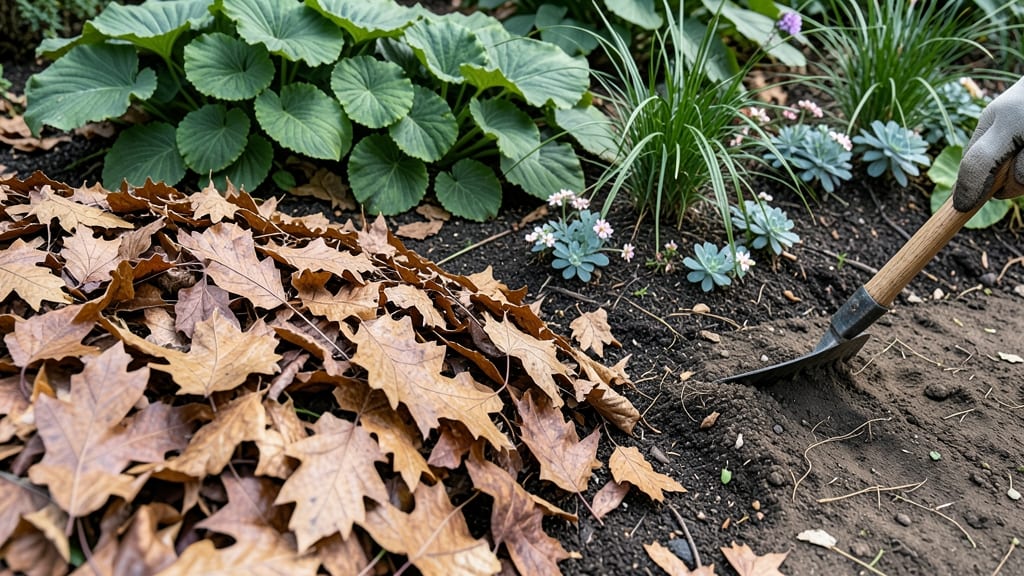
Leaving leaves on garden beds provides natural mulching that conserves soil moisture and blocks weeds, but you should remove them if they're diseased, moldy, or harbor pests. Shredding speeds up decomposition, while thick piles can suffocate plants or attract rodents. Evaluate leaf quality and your garden's specific needs before deciding.
Deciding whether to leave leaves on garden beds depends on their condition and your garden's health. Healthy, disease-free leaves act as a protective blanket, shielding soil from temperature extremes and suppressing weeds by blocking sunlight. 🌿 Over time, they decompose into nutrient-rich humus that improves soil structure—ideal for perennials and established plants.
However, thick layers can create anaerobic conditions that harm roots, while diseased leaves may spread pathogens to your plants.
For pest-prone or diseased leaves, removal is essential. Rake them into compost piles (if pest-free) or dispose of them in yard waste. In early spring, a light layer of shredded leaves works best—just 2-3 inches—to prevent smothering while still offering benefits.
If you're unsure, test a small area first to monitor plant response.
💡 In This Article
- How Mulching Leaves Protects Soil and Plants
- When and How to Remove Garden Leaves Safely
How mulching leaves protects soil and plants
Leaf mulch works like a living blanket for your garden, creating a microclimate that regulates temperature and moisture. When leaves decompose, they release organic matter that binds soil particles, improving aeration and water retention.
A 2-3 inch layer of shredded leaves can reduce soil temperature fluctuations by up to 10°F compared to bare soil, protecting roots during heatwaves and insulating them in winter. This process also feeds soil microbes, which break down complex organic material into plant-accessible nutrients like nitrogen and phosphorus.
The decomposition rate varies dramatically between whole and shredded leaves.
Whole leaves take 12-18 months to break down completely, while shredded leaves decompose in just 3-6 months due to increased surface area for microbial activity. 🌱 This faster breakdown means shredded leaves provide quicker benefits for soil structure and nutrient release.
However, overly thick layers (over 4 inches) can create anaerobic conditions, smothering beneficial organisms and preventing proper water penetration.
For moisture retention, leaf mulch can reduce evaporation by up to 30% compared to bare soil. This is especially valuable during dry spells, as the mulch layer shields soil from direct sunlight while allowing gradual water penetration.
The porous structure also prevents soil compaction from rain, maintaining optimal root growth conditions. Unlike synthetic mulches, organic leaf mulch gradually improves soil fertility as it decomposes, making it a sustainable long-term solution.
One often-overlooked benefit is weed suppression. Leaf mulch blocks 90% of sunlight from reaching weed seeds, preventing germination while allowing established plants to thrive. The dense mat also disrupts weed growth by making it difficult for young shoots to penetrate.
However, this effect diminishes with thicker layers that may compress over time, losing their insulating properties.
For best results, combine leaf mulch with other organic materials like grass clippings or compost. This creates a balanced decomposition rate that prevents nitrogen depletion in the soil.
The ideal mulch blend should contain 60% leaves and 40% other organic matter to maintain proper microbial activity and nutrient availability throughout the growing season.