
Vegetables
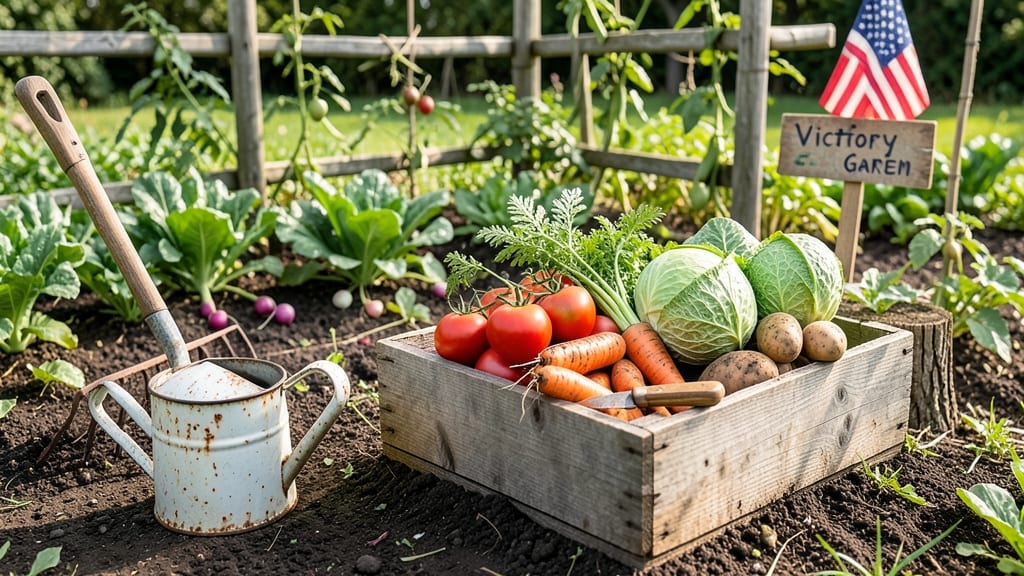
Victory gardens during WW2 were small-scale vegetable plots planted by American families to support the war effort, producing nearly 40% of the nation's fresh produce and conserving resources for troops overseas through homegrown foods like tomatoes, potatoes, and leafy greens.
During World War II, these gardens became a patriotic movement—over 20 million Americans grew food on any available space, from backyards to vacant lots. 🌱 The U.S. government actively promoted them through posters and radio broadcasts, framing homegrown produce as a direct contribution to the war effort.
What's fascinating is how these gardens adapted to urban environments, proving that even small plots could make a huge difference when coordinated across the country.
Many families planted "liberty gardens" as a symbol of their commitment, often growing vegetables they'd normally purchase. This not only reduced grocery demand but also created a sense of community resilience during rationing times.
The success of these gardens laid the foundation for modern community gardening movements and urban agriculture initiatives.
💡 In This Article
- How WW2 Victory Gardens Boosted Food Production
- Best Crops for Modern Victory Garden Replicas
How WW2 victory gardens boosted food production
At the heart of victory gardens was a brilliant wartime strategy combining government coordination with grassroots participation.
The U.S. Office of Civilian Defense launched campaigns like "Food Will Win the War," distributing free seeds through programs like the Victory Garden Seed Program, which provided 3 million packets of vegetable seeds in 1943 alone.
These weren't just any seeds - they were selected for high yield and quick harvests, prioritizing crops that could be grown in small spaces like radishes (ready in 25 days) and lettuce (30 days) over slower-maturing vegetables.
The campaign targeted both rural and urban areas with tailored approaches. Rural families expanded existing plots, while urban dwellers transformed balconies, rooftops, and even window boxes into productive spaces. In cities like New York, 100,000+ gardens sprouted in vacant lots, producing 1 million pounds of vegetables weekly by 1944.
The government even published Victory Garden Manuals with space-saving techniques like vertical growing and trellis systems for vining plants—innovations still used in modern urban farming. 🌱
What made this system work was its adaptability to wartime conditions. With 6 million men serving overseas, women took on agricultural roles through programs like Women's Land Army, operating tractors and managing farms.
Meanwhile, victory gardens reduced grocery demand by 40% for fresh produce, freeing up shipping for military supplies. The psychological impact was equally significant—growing food became an act of patriotism that fostered community during rationing times.
One fascinating mechanism was the "garden-to-table" cycle. Families planted high-calorie crops like potatoes and corn for direct consumption, while leafy greens and carrots were preserved through canning (a skill many learned through government workshops).
This reduced food waste and ensured nutrients reached both soldiers and civilians. The system proved that decentralized food production could be just as effective as large-scale farming when coordinated properly.
Urban gardens faced unique challenges but achieved remarkable results through creativity. For example, New York's Community Gardens organized shared plots where neighbors contributed labor and shared harvests. In Detroit, 100 acres of vacant lots were converted to gardens, producing enough food to feed 25,000 people annually.
The success of these urban plots demonstrated that even small spaces could contribute meaningfully when organized systematically.
The victory garden movement also introduced sustainable practices that resonate today. Many families composted kitchen scraps and used rainwater collection systems, reducing waste at a time when resources were scarce.
This holistic approach to food production—combining practical agriculture with community engagement—created a model that still influences modern urban farming initiatives. 💫