
Tools
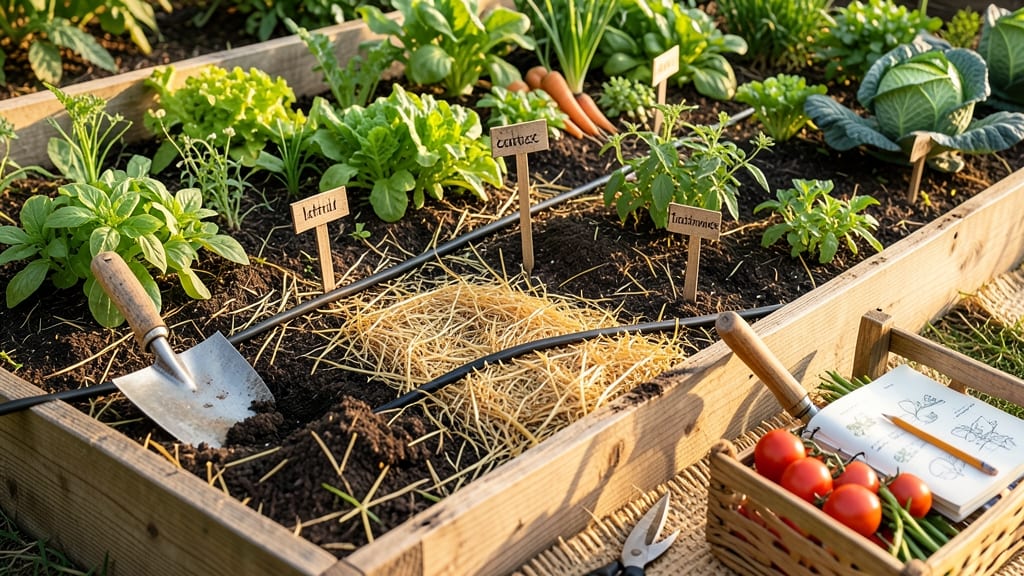
A market garden is a small-scale farming operation that grows high-value crops like vegetables, herbs, and flowers specifically for direct sales to local customers, restaurants, and farmers' markets. These operations focus on maximizing efficiency and diversity with quick harvest cycles.
A market garden thrives on its ability to produce a wide variety of crops in small spaces, often using intensive planting techniques like succession planting to keep harvests coming year-round. 🌱 Unlike traditional farms that prioritize large-scale monocultures, market gardens specialize in what sells fastest—think leafy greens, heirloom tomatoes, and fresh herbs.
The direct-to-consumer model means farmers can command premium prices while reducing waste by selling what's freshly harvested.
This approach also allows for more experimentation with crop varieties and growing methods. For example, many market gardeners use raised beds or hydroponics to optimize space and control soil quality.
The key difference from traditional farming isn't just size—it's the speed and flexibility to adapt to local demand, making it perfect for urban areas or regions with short growing seasons.
💡 In This Article
- How Market Gardens Differ From Traditional Farms
- Key Crops and Techniques for Successful Market Gardening
How market gardens differ from traditional farms
Market gardens operate on a fundamentally different scale than traditional farms, with acreage typically ranging from ¼ to 5 acres—far smaller than the hundreds or thousands of acres found in commercial agriculture.
This compact size allows for diverse crop rotations that prevent soil depletion, unlike monoculture systems where the same crop (like corn or soybeans) dominates vast fields year after year. 🌱 The diversity in market gardens means farmers can grow 50+ varieties in a single season, from microgreens to heirloom tomatoes, compared to 1-3 crops in large-scale operations.
The real innovation lies in their sales strategy. Traditional farms rely on wholesale distribution—selling bulk produce to grocery chains or processors—which often means lower profit margins and longer storage times.
Market gardens, however, cut out the middleman by selling directly to consumers at farmers' markets, CSAs (Community Supported Agriculture), or through farm stands. This direct connection lets them charge 20-50% more per pound for fresh, locally grown produce, like $3/lb for heirloom carrots versus $1/lb in supermarkets.
Time is another critical factor. Market gardens prioritize fast-growing crops with harvest cycles under 60 days, such as radishes, lettuce, or green onions, ensuring a steady stream of fresh inventory. Traditional farms often focus on slower-growing staples like wheat or alfalfa, which require 6+ months to mature.
This speed allows market gardeners to respond instantly to demand—if kale sells out, they can replant within days rather than waiting for a full season.
Technology also plays a different role. While traditional farms might use heavy machinery for large-scale tilling, market gardens often employ hand tools, raised beds, or drip irrigation to conserve space and labor.
For example, a 4'x8' raised bed can yield 200+ lbs of leafy greens per season, while a comparable area in conventional farming might produce only 50 lbs due to wider row spacing. The emphasis is on precision and efficiency, not sheer acreage.
Climate adaptation is where market gardens truly shine. Traditional farms often specialize in one or two crops suited to their region, but market gardeners use techniques like season extension (hoop houses, cold frames) to grow year-round.
A prime example: spinach can be harvested in 30 days in spring, replanted for summer, and again in fall—something impossible for large-scale operations tied to seasonal cycles. This flexibility lets them supply restaurants with fresh herbs even in winter.
Finally, the environmental impact differs dramatically. Traditional farms often rely on synthetic fertilizers and pesticides to maintain yields across vast areas, while market gardens use compost, cover crops, and integrated pest management to build soil health naturally.
A study by the University of Michigan found that market gardens can achieve 30% higher biodiversity per acre than conventional farms due to their diverse planting patterns. 🌿