
Tools
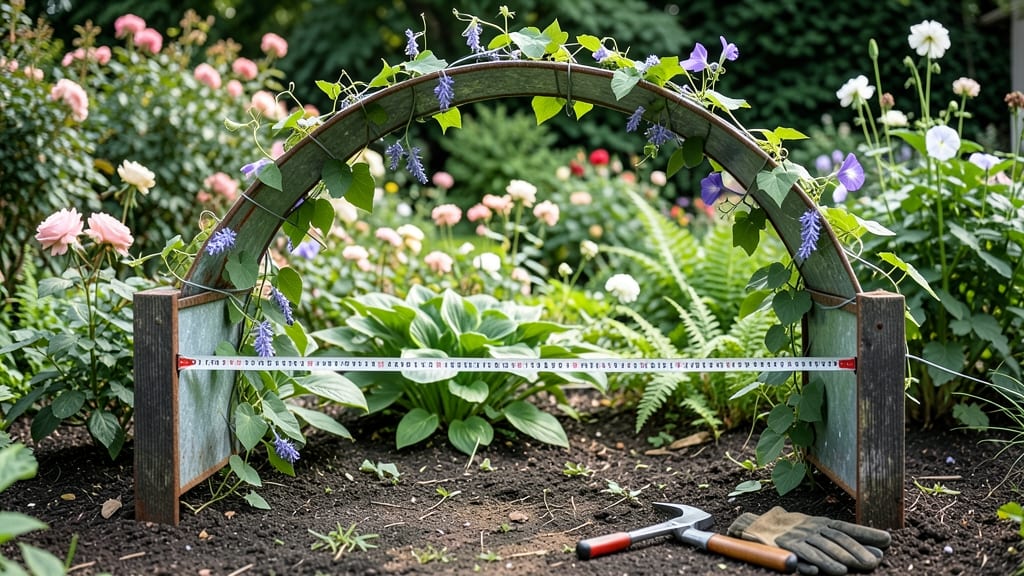
For a garden arch, the what size cattle panel standard is a 4-foot height and 48-inch width, with spans kept under 6 feet to prevent sagging. Adjust panel height for climbing plants or entryways, and add support posts every 4–6 feet for heavy vines or trellises.
Cattle panel arches rely on these dimensions because a 4-foot height provides enough clearance for most climbing plants while keeping the structure manageable.
The 48-inch width ensures the panels fit standard hardware and create a sturdy frame without excessive weight. 🌿 For heavier plants like grapes or wisteria, consider doubling the panels or adding diagonal bracing—this prevents bending under seasonal growth.
The 6-foot span limit comes from engineering principles: wider arches require additional support posts to distribute weight evenly and prevent structural stress.
Pro tip: For entryway arches, you might opt for 5-foot panels to create more dramatic clearance, but always check local building codes if the structure will bear significant weight. The key is balancing aesthetics with structural integrity—your arch should look beautiful while lasting years without sagging.
💡 In This Article
- How Cattle Panel Dimensions Affect Garden Arch Stability
- Calculating Cattle Panel Arches for Climbing Plants and Trellises
How cattle panel dimensions affect garden arch stability
The 4-foot height standard for cattle panel arches isn't arbitrary—it's a balance between aesthetics and structural physics. A 48-inch-wide panel provides the optimal width-to-height ratio for most garden applications, distributing weight evenly while allowing enough surface area for climbing plants to latch onto.
The 1/4-inch steel thickness (standard for most cattle panels) can support 100–150 pounds per square foot when properly braced, but this load capacity drops significantly if the span exceeds 6 feet.
At that point, the panel's natural curvature creates a bending moment that stresses the metal, leading to sagging over time.
Arch height directly impacts wind resistance and plant support. A 4-foot arch creates a 2-foot clearance at the center when bent into a semi-circle, ideal for roses or clematis that need vertical space to grow upward.
The 48-inch width ensures the panel's natural rigidity is maintained—wider panels (like 60-inch) require additional bracing because their increased surface area catches more wind, creating lateral forces that can twist the structure.
For comparison, a 5-foot-tall panel increases wind load by ~30% due to the larger surface area exposed to gusts, which is why most gardeners stick to 4-foot unless building a dramatic entryway.
Span length is where physics gets interesting. The 6-foot rule comes from basic beam theory: a 48-inch-wide panel bent into a 6-foot arch creates a 3:1 ratio of span to height, which is the structural sweet spot for cattle panels.
Exceed this, and you're asking the metal to bend beyond its elastic limit—think of it like bending a ruler too far; it'll eventually snap under load. For longer spans, 1/2-inch-thick panels or double-layered panels become necessary, but these add significant weight and cost.
The 1/4-inch steel standard works beautifully for most garden arches because it's light enough to handle with basic tools but sturdy enough to support 20–30 pounds per linear foot of plant weight.
Material thickness matters more than most realize. A 1/4-inch panel can handle ~100 pounds per square foot of downward pressure, but wind loads add horizontal stress that reduces this capacity by 20–40%.
This is why diagonal bracing (using 2x4s or metal angles) becomes critical for spans over 5 feet.
The 48-inch width also ensures the panel's horizontal ribs (the vertical metal strips) align properly with standard 3-foot post spacing, creating a stable triangle of support that resists both vertical and lateral forces.
Without this alignment, the arch can develop a "waist" in the middle, where the panel sags under its own weight.
Consider this real-world example: A 4-foot-tall, 48-inch-wide arch spanning 5 feet with 3-foot posts will support clematis or morning glories with ease, but the same arch spanning 7 feet will require additional center posts or heavier-duty panels. The difference?
At 7 feet, the panel's natural curvature creates a 12-inch sag in the center without support, which is enough to stress the metal and cause permanent deformation.
For heavy climbers like wisteria or grapes, this sag becomes a safety hazard as the plants pull the arch downward during growth.
Pro tip: If you're building for heavy vines, opt for double-layered panels (two panels welded together) or add diagonal cross-bracing every 3–4 feet. This increases load capacity by ~50% while keeping the structure lightweight enough for DIY assembly.
The key is understanding that cattle panels are rigid in one direction (width) but flexible in another (span)—working with these natural properties is what makes garden arches both beautiful and functional. 🌿