
Tools
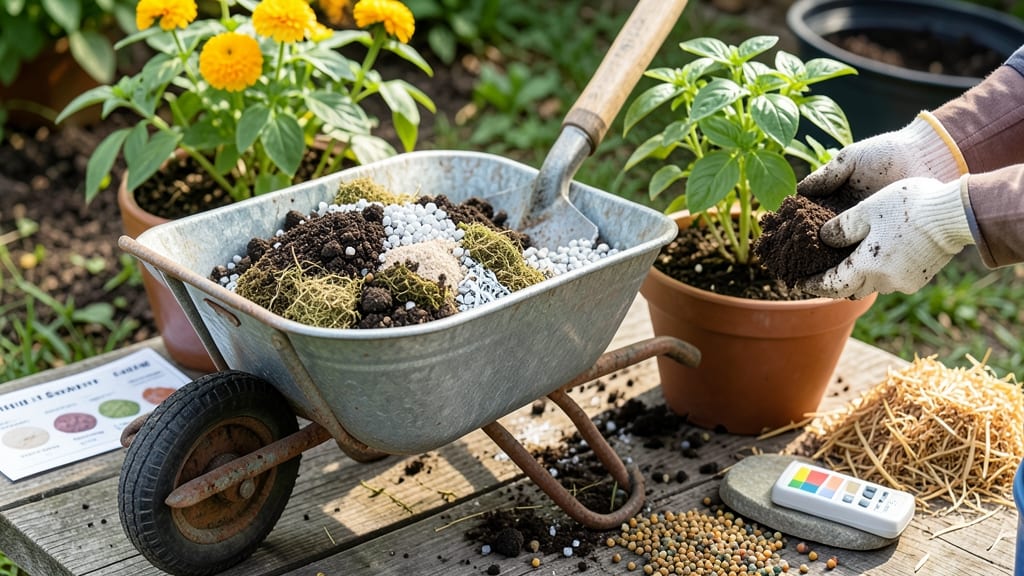
For garden soil, use a mix of compost, topsoil, peat moss, coconut coir, sand, and perlite depending on plant needs and drainage requirements. Organic matter like compost improves fertility, while sand and perlite enhance aeration for root growth.
Creating the perfect garden soil mix starts with understanding how each ingredient plays a unique role. Compost acts as nature's fertilizer, packed with microbes that break down organic matter into nutrients plants can absorb, while peat moss and coconut coir retain moisture to prevent drought stress. Sand and perlite are game-changers for drainage, especially in heavy clay soils where roots need room to breathe. 🌱 The key is balancing these components based on your plants' needs—leafy greens thrive in nutrient-rich mixes, while succulents demand fast-draining blends with extra perlite.
Don't overlook your local climate—regions with high rainfall benefit from more perlite, while dry areas need extra moisture-holding coconut coir. I always test my soil's drainage by filling a jar with your mix and adding water; if it drains within 30 minutes, you're on the right track.
For beginners, pre-mixed bags labeled for "garden soil" or "potting mix" offer a solid starting point, though custom blends often yield better results for specific plants.
💡 In This Article
- How Different Soil Amendments Improve Garden Health
- Best Soil Mix Recipes for Common Plants and Climates
How different soil amendments improve garden health
Every soil amendment plays a distinct role in your garden's ecosystem. Compost is the powerhouse—it teems with beneficial microbes that decompose organic matter, releasing nutrients like nitrogen, phosphorus, and potassium over time. These microbes also form symbiotic relationships with plant roots, enhancing nutrient uptake.
A well-aged compost has a dark, crumbly texture with an earthy aroma, and its pH typically ranges between 6.0-8.0, making it versatile for most plants. 🌱
Peat moss and coconut coir serve as moisture reservoirs, holding up to 20 times their weight in water while still allowing oxygen to reach roots. Peat moss has a slightly acidic pH (3.5-4.5), ideal for acid-loving plants like blueberries, while coir is more neutral (5.5-6.8) and sustainable. Both break down slowly, maintaining structure in your soil mix for months. The fibrous texture of coir also improves soil aeration better than peat moss, which can compact over time.
Drainage is where sand and perlite shine. Coarse sand (like builder's sand) improves water infiltration in heavy clay soils, while perlite—made from volcanic glass—adds 40-50% air space to your mix. This aeration prevents root suffocation, especially in containers where water can't drain away.
Perlite also has a neutral pH, so it won't alter your soil's acidity. For comparison, a mix with 20% perlite drains 3 times faster than pure topsoil, making it ideal for succulents and cacti.
Don't forget about worm castings, often called "black gold" for their nutrient density. They contain 5 times more nitrogen than compost and release nutrients slowly, feeding plants for weeks.
The best blends combine these amendments in ratios that match your plants' needs—leafy greens need more compost (50%), while tomatoes benefit from a balanced mix of compost, perlite, and coir (40-30-30).
Here's how to test your soil's health: Fill a jar with your mix, add water, and shake. Let it settle for 30 minutes. The top layer should be 20-30% air space (perlite/sand), the middle 40-50% organic matter (compost/coir), and the bottom 20-30% mineral particles (sand/clay).
If your mix drains too fast, add more coir; if it stays soggy, incorporate perlite. 💫
Advanced gardeners often customize mixes by plant type. For example, a succulent blend might be 60% perlite, 20% pumice, and 20% compost, while a vegetable mix could be 50% compost, 30% topsoil, and 20% coconut coir.
The key is observing how your plants respond—wilting leaves often signal poor drainage, while yellowing indicates overwatering or nutrient deficiencies.