
Tools
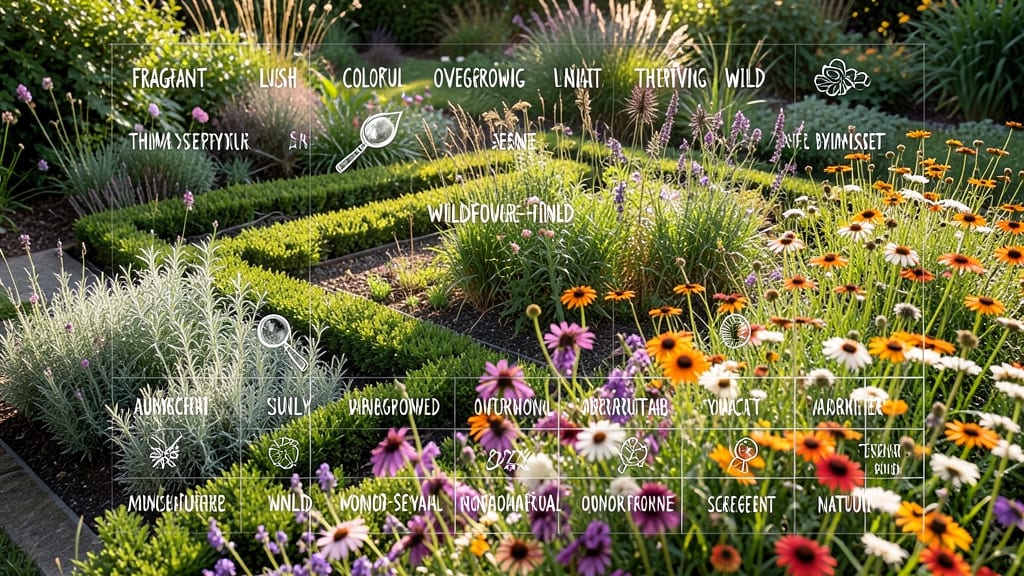
Using adjectives to describe a garden like "lush," "vibrant," and "fragrant" transforms a simple space into a vivid sensory experience that reflects its seasonal transformations and emotional impact.
Adjectives don't just paint a picture—they create an atmosphere. 🌿 A well-chosen word like "whimsical" can instantly evoke a child's garden, while "majestic" suits towering oak canopies. The right descriptors also help gardeners connect emotionally with their spaces, whether they're designing a tranquil retreat or a bold, experimental landscape.
Consider how light and scent play into your word choices. A morning garden might be "dewy" and "silent," while an evening space could feel "moonlit" and "hushed." These details make descriptions feel alive and immersive, helping readers (or visitors) experience the garden before they even step into it.
For practical use, I recommend keeping a small notebook by your garden gate. Jot down the words that come to mind when you're there—your instincts often know exactly what captures the essence better than any dictionary could.
💡 In This Article
- How Seasonal Changes Transform Garden Descriptions
- Emotional and Sensory Adjectives for Garden Writing
How seasonal changes transform garden descriptions
Seasonal shifts don't just change what grows in your garden—they completely reshape how we describe it. In spring, words like "blooming" and "awakening" dominate because photosynthesis accelerates as temperatures rise above 50°F, triggering rapid plant growth.
The increased sunlight (up to 14 hours/day in summer) creates vibrant colors that demand adjectives like "radiant" or "sun-drenched", while winter's shorter days and cooler temperatures (40°F) inspire "dormant", "quiescent", or "resting"—terms that reflect plants' metabolic slowdown.
The angle of sunlight changes dramatically too. In summer, the low morning light casts long shadows, making gardens feel "dappled" or "filtered", while winter's high-angle sunlight creates stark contrasts that evoke "crisp" or "frost-kissed" descriptions.
Even the air's humidity shifts: summer's 60-80% humidity makes gardens feel "lush" and "sweat-laden", while autumn's 40-60% humidity transforms them into "crisp" or "aromatic" spaces. These physical changes force us to adjust our vocabulary to match the sensory reality.
Plant life cycles also dictate our word choices. Spring's "tender" new growth contrasts sharply with autumn's "resilient" perennials that persist despite cooler temperatures. The scientific term "phenology"—the study of seasonal plant cycles—explains why we associate "bursting" with spring bulbs and "golden" with autumn foliage.
Even the scent profile shifts: spring's "fresh" and "green" aromas give way to summer's "spicy" (like rosemary) and autumn's "earthy" (compost piles) or "woody" (conifers) fragrances.
Consider how light quality affects color perception too. Summer's intense sunlight makes reds appear "bold" while winter's diffused light softens them to "muted" or "velvety". This phenomenon, called "metamerism", is why the same rose bush might be described as "flamboyant" in July but "delicate" in November.
The key is to match your adjectives to these measurable environmental factors—temperature, sunlight duration, and humidity—to create descriptions that feel authentically seasonal.
For practical application, keep a "seasonal word bank" by your garden bench. Note how the same plant changes descriptions across seasons—your hydrangeas might be "romantic" in spring (when blooming), "lush" in summer (full foliage), and "whimsical" in autumn (dried blooms).
This exercise trains you to notice the subtle shifts that make garden writing feel dynamic and alive.
One advanced technique is to pair seasonal adjectives with specific times of day. A morning garden in spring might be "dewy" and "silent", while the same space at dusk could feel "moonlit" and "hushed." This temporal layering adds depth to your descriptions, making them feel more immersive.
The science of "circadian rhythms" in plants (their internal clocks) even influences these daily shifts—notice how some flowers open only in morning sunlight, inspiring "ephemeral" or "fleeting" descriptors.