
Watering
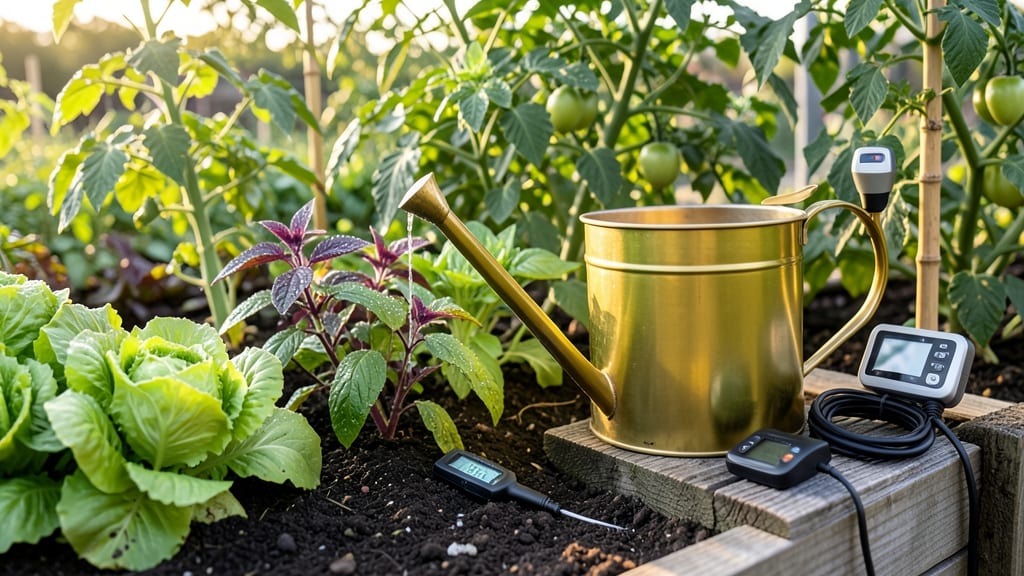
To determine how long to water your garden, consider soil type: sandy soil requires 5-10 minutes per zone, loamy soil needs 10-15 minutes, and clay soil demands 15-20 minutes for proper saturation. Always adjust based on weather conditions and water in the early morning to minimize evaporation and fungal growth.
Your garden's soil type directly impacts how long you should water because different textures absorb moisture at varying rates. 💧 Sandy soil drains quickly, so shorter bursts prevent runoff, while clay holds water longer but risks suffocating roots if overwatered.
I've found that testing soil moisture with your finger—about 2-3 inches down—gives a better sense of need than timing alone. For example, during summer heatwaves, I often double the recommended time for loamy soil to account for increased evaporation.
Another key factor is plant type—deep-rooted perennials like lavender need longer, less frequent watering compared to shallow-rooted lettuce. 🌱 Always observe your plants: wilting leaves or yellowing stems signal either too much or too little water.
Pro tip: Use a rain gauge to track weekly rainfall and adjust accordingly, as this can cut your watering time by 30-50% during rainy seasons.
💡 In This Article
- Soil Type and Watering Duration: Science Behind Absorption Rates
- Optimizing Garden Watering Schedules by Season and Plant Needs
Soil type and watering duration: science behind absorption rates
The way your garden drinks water depends entirely on its soil composition. Sandy soil, made up of large particles, drains water like a sieve—moisture moves through it in just 5-10 minutes, leaving little for roots to absorb.
This is why sandy gardens need frequent, short watering sessions to prevent nutrients from washing away. Think of it like pouring water through a colander: most escapes immediately, requiring you to repeat the process every 2-3 hours during hot days.
Loamy soil, the gardener's gold standard, balances particle sizes perfectly. With roughly 40% sand, 40% silt, and 20% clay, it holds moisture like a sponge while allowing air to circulate—ideal for most plants.
Water penetrates about 6-8 inches deep in 10-15 minutes of watering, creating the perfect environment for root development. The key here is consistency: loamy soil maintains moisture longer than sandy soil but won't suffocate roots like clay. 💧
Clay soil presents the opposite challenge—its tiny particles pack tightly, creating a waterlogged environment that can drown roots. Water moves slowly (15-20 minutes for saturation), but the real issue is how it clings. A single watering session can leave the top 4-6 inches soggy for days, cutting off oxygen.
The solution? Longer, less frequent waterings combined with organic matter (like compost) to improve drainage over time. I've seen clay gardens transform when amended with 3-4 inches of compost—roots suddenly thrive where they once struggled.
Here's where things get interesting: soil texture affects more than just watering time. Sandy soils lose water 3-4 times faster than loamy soils during dry spells, while clay can hold 2-3 times more moisture but risks compaction.
The secret is testing your soil's moisture level by sticking your finger 2-3 inches deep—if it feels dry, it's time to water. For clay-heavy gardens, I recommend using a soil moisture meter ($15-$25 range) to avoid overwatering.
Don't overlook the role of organic matter in changing these dynamics. Adding 2-3 inches of compost annually can improve sandy soil's water retention by 20-30% while helping clay soils drain 15-20% better.
The microbial activity in compost also breaks down organic material, creating tiny pores that act like natural water channels. This is why healthy soil often requires less frequent watering—it's not just about the minerals, but the living ecosystem working with you. 🌱
For visual learners, imagine soil particles as a building: sand is like a house of cards (quick to collapse), clay is solid concrete (hard to penetrate), and loam is brick-and-mortar (just right).
Your watering strategy should match this structure—adjusting not just duration but also frequency and technique to match your garden's unique makeup.