
How Much to Water Garden Plants: Exact Times by Plant Type and Season

Watering

How Much to Water Garden Plants: Exact Times by Plant Type and Season

To water garden plants correctly, you need 1-3 inches of water per week—but the real trick is timing it right to avoid drowning roots or stressing plants.

Most gardeners overwater by default, thinking more is always better. Yet soggy soil chokes roots just as fast as dry soil wilts leaves. The key is understanding how much your 🌱 General Garden truly needs based on its type and your climate.

In USDA Zone 6a, spring watering starts with a deep soak after planting to settle soil, but summer demands shift to morning sessions to prevent evaporation and fungal growth. Forget a one-size-fits-all approach—succulents beg for dry spells while tomatoes drink up every drop.

Below, I break down exact watering schedules by plant, how to spot over/underwatering, and the tools (like moisture meters) that take the guesswork out of keeping your garden thriving.

🌻
🚿
💧
Frequency
Every 3-7 days (depending on plant and weather)
🥛
Amount
Deep soak (1-3 inches of water per week) (2500)
🌅
Best Time
Morning

Watering requirements by plant type: exact inches and frequency

Understanding how much to water your garden isn't about guessing—it's about measuring. Most plants thrive when they receive 1-3 inches of water per week, but the exact amount depends on the plant type, soil depth, and growth stage.

For example, leafy greens like lettuce need 1 inch weekly, while thirsty tomatoes require 2-3 inches during fruiting. Let’s break down the science so you can water with precision.

Soil depth matters more than you think. Water should penetrate 6-12 inches deep for most plants to encourage deep root growth. Shallow watering (just the top inch) stresses roots and leads to weak plants.

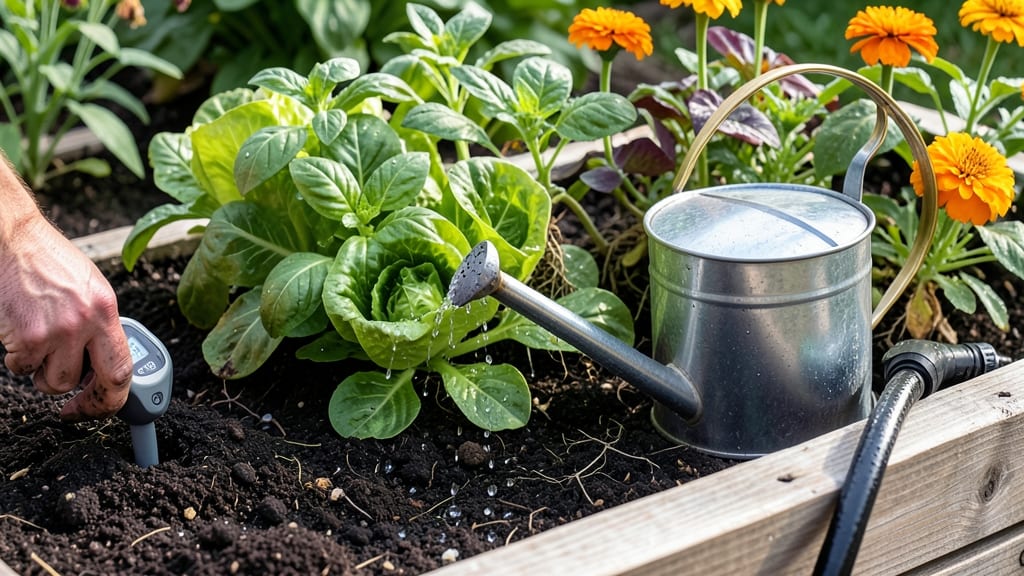
Use a soil probe or your finger to check moisture—if the soil feels dry 2 inches down, it’s time to water. This method works for vegetables, flowers, and herbs alike.

Here’s the key: Drought-tolerant plants like lavender and rosemary only need 0.5-1 inch per week, while water-loving plants such as cucumbers and peppers demand 2-3 inches. The comparison below shows exact needs for common garden staples, so you can tailor your watering schedule like a pro.

Plant Watering Comparison: Inches & Frequency

Plant Type Water Depth (inches/week) Frequency (Days) Growth Stage Needs Drought Tolerance
Leafy Greens (Lettuce, Spinach) 1 3-4 1 inch/week; more in heat Moderate
Tomatoes & Peppers 2-3 2-3 2-3 inches; critical during fruiting Low
Herbs (Basil, Cilantro) 0.75-1.5 3-5 1 inch; basil wilts easily Moderate
Flowers (Marigolds, Zinnias) 1-1.5 3-5 1 inch; adjust for blooming High
Succulents & Lavender 0.5 7-10 0.5 inch; let soil dry completely Very High
Root Vegetables (Carrots, Potatoes) 1.5-2 4-5 1.5 inches; keep soil moist Moderate

Seasonal watering adjustments: when to increase or reduce

Your garden's watering needs shift dramatically with the seasons—what works in spring can drown plants by summer. In USDA Zone 6a, I adjust my schedule based on temperature, humidity, and rainfall to prevent waste while keeping roots hydrated.

The key is understanding how evaporation rates change: a 90°F day can lose 3x more water than a 70°F one.

Automatic irrigation systems need seasonal tweaks too. I set mine to run 20% longer in July than in May, but always check soil moisture first. Over-reliance on timers leads to soggy soil—especially for perennials that hate "wet feet."

Let’s break down how to adjust your watering by season, plus how to calculate your local evaporation rate.

Season Watering Goal Frequency Evaporation Rate Automation Tip
Spring Deep soak after planting 1x/week (adjust for rain) Moderate (0.25"-0.5"/day) Set timers for 10-15 mins
Summer Morning watering (1-2" weekly) 2-3x/week (daily for containers) High (0.5"-1"/day) Increase runtime by 30-50%
Fall Reduce as temps drop 1x/week (bi-weekly by Oct) Low (0.1"-0.25"/day) Cut automation by 50%
Winter Minimal for perennials Bi-weekly (or none if frozen) Negligible (ice cover) Turn off systems

To calculate your local evaporation rate, multiply your average daily temperature by 0.05 (e.g., 80°F × 0.05 = 0.4" water loss/day). In my Zone 6a garden, this means summer watering sessions must be 2x longer than spring ones to compensate.

For example, a 10-minute spring session becomes 20 minutes in July.

Watch for leaf curl or yellowing—these are red flags for overwatering in cool seasons. In contrast, wilting by noon signals underwatering during heatwaves. I use a moisture meter to verify soil conditions before adjusting my schedule.

For automatic systems, program seasonal overrides: reduce runtime by 40% in fall and pause entirely in winter unless protecting tender plants.

Pro tip: Group plants by water needs to simplify adjustments. Succulents and lavender thrive on neglect in summer, while tomatoes and peppers demand daily attention. Mulch with 2-3 inches of straw to lock in moisture and cut evaporation by 30%—a game-changer for hot climates.

🌱

★★★★★5.0(5 reviews)
Categories Watering