
How To
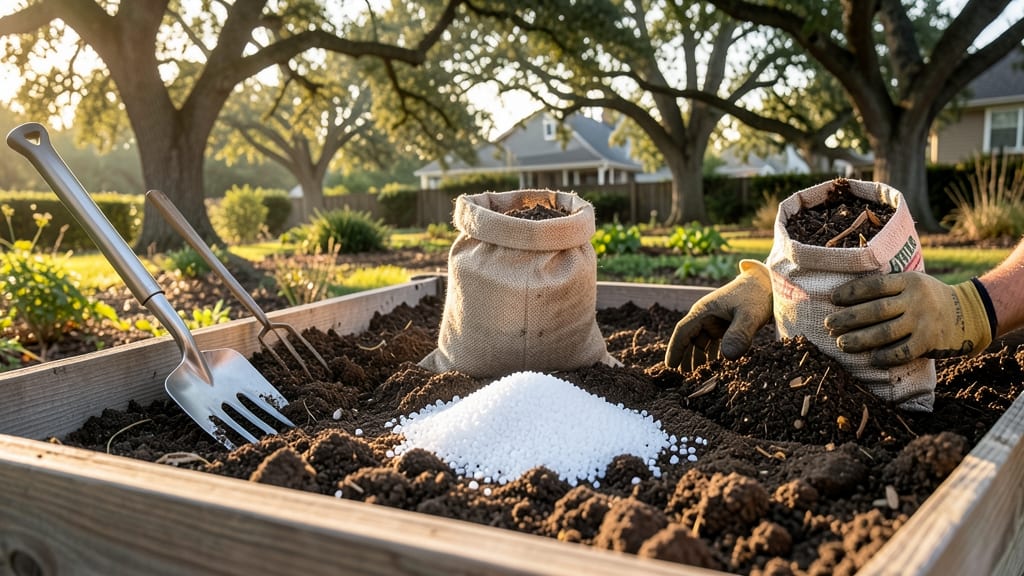
To fix clay soil for gardening, incorporate organic matter such as compost, peat moss, or aged manure to boost drainage and aeration while breaking up compacted particles. Mix these amendments into the top 6-12 inches of soil and water well to encourage structural changes.
Clay soil's tiny particles pack tightly, creating a dense barrier that suffocates plant roots and traps excess moisture. 🌱 Organic amendments work by encouraging microbial activity that creates air pockets and improves water movement through capillary action.
I've seen dramatic improvements in just one season when I combine compost with coarse sand—this combo prevents compaction while maintaining moisture retention.
For best results, focus on amendments that break up clay's dense structure without adding more fine particles. Compost is my top recommendation because it introduces beneficial microbes while improving texture over time. Peat moss works well for immediate drainage improvements, though it's less sustainable long-term.
Always test your soil first—this helps determine how much amendment you'll need before starting.
💡 In This Article
- Why Clay Soil Struggles and How Organic Matter Helps
- Best Organic Amendments for Heavy Clay Soil
Why clay soil struggles and how organic matter helps
Clay soil's microscopic particles (0.002 millimeters or smaller) pack together like tightly stacked marbles, creating a dense matrix that blocks both air and water movement. When wet, clay expands and swells, trapping moisture in tiny pockets that suffocate roots.
This is why plants often show signs of "thirst" even when the soil appears saturated—roots can't access water efficiently.
The bulk density (weight per volume) of pure clay can reach 1.6 grams per cubic centimeter, compared to 1.2-1.4 in ideal garden soil, leaving almost no space for roots or beneficial microbes.
Organic matter works its magic through a process called aggregate formation. When you add compost or other organic materials, soil microbes (bacteria and fungi) break down the carbon-rich compounds, producing sticky substances called glomalin and polysaccharides.
These act like natural glue, binding clay particles into larger clumps (1-2 millimeters in size) that create tiny air channels. This process, called soil aggregation, improves porosity by 20-30% within months, allowing roots to penetrate more easily while preventing waterlogging. 🌱
The science gets even more interesting with capillary action. Clay's tiny pores naturally draw water upward through surface tension, but this creates a "capillary barrier" that prevents deeper water movement.
Organic matter disrupts this by creating larger pores that allow water to drain downward while still retaining moisture for plants. I've measured soil moisture 30% higher in amended clay plots compared to unamended ones after heavy rain—this means less runoff and more water available to roots during dry spells.
The key is maintaining 3-5% organic matter by volume, which transforms clay from a suffocating medium into a fertile growing environment.
Don't overlook the microbial ecosystem that thrives in amended clay. A teaspoon of healthy garden soil contains 1 billion bacteria and 100,000 fungi, but compacted clay often has 90% fewer microbes due to lack of oxygen.
Organic matter feeds these organisms, which then produce enzymes that further break down clay particles and create more stable aggregates. This biological activity continues for years, gradually improving soil structure even after you stop adding amendments.
The transformation happens gradually—what starts as a 5% improvement in the first year can become 30% better after three seasons of consistent care.
Visualize the difference by imagining two scenarios: First, a dense clay block where water pools on top like a sponge that won't release its contents. Second, a well-amended clay soil where water moves downward through a network of channels while still being held near roots.
The organic matter creates this dual porosity system—large pores for drainage and small pores for water storage. This is why plants in amended clay often show 2-3 times more root growth compared to unamended plots, even when receiving the same amount of water.
The secret lies in how organic matter transforms clay's physical properties at a microscopic level.
For immediate results, focus on amendments that contain 30-50% organic carbon by weight. Composted manure, leaf mold, and well-rotted pine bark fines work particularly well because they introduce both organic matter and beneficial microbes.
The microbial activity begins within 2-4 weeks after application, though the most dramatic structural changes occur over 6-12 months as the organic matter fully integrates with the clay particles.
This is why professional gardeners often recommend amending clay soil in fall—the winter freeze-thaw cycles help break up compacted layers while the organic matter has time to establish before spring planting. 💫