
Tools
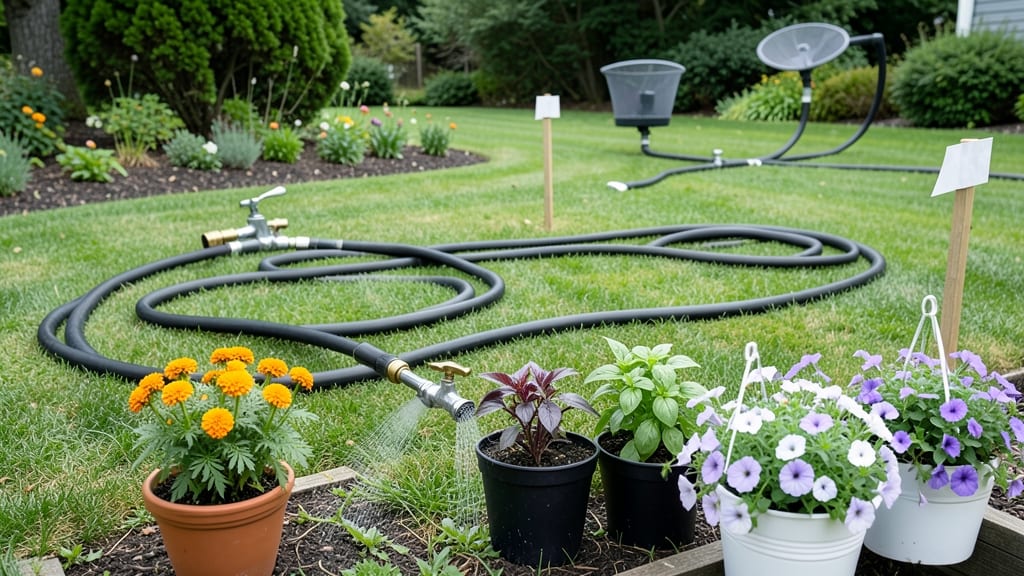
The longest garden hoses available reach up to 250 feet, designed with reinforced rubber or heavy-duty vinyl to handle extensive watering needs. These premium hoses are engineered for large properties, farms, or commercial irrigation setups where standard lengths fall short.
The length of a garden hose directly impacts its performance, especially in terms of water pressure and durability.
Every 25 feet of hose reduces water flow by about 10 psi, so a 250-foot hose can lose significant pressure unless it's reinforced with braided nylon or thick rubber layers. 💧 These materials prevent kinks and leaks while maintaining flexibility—critical for large-scale watering tasks like filling livestock tanks or irrigating sprawling fields.
For practical use, these extended hoses shine in commercial irrigation or multi-zone sprinkler systems where reach matters most. I always recommend storing them in spiral coils to prevent tangling and using heavy-duty connectors to avoid pressure points.
The trade-off? Longer hoses weigh more and require stronger storage solutions, but the convenience for large properties makes them worth the investment.
💡 In This Article
- How Long Garden Hose Length Affects Water Pressure and Durability
- Best Uses for Extra-Long Garden Hoses in Landscaping and Farming
How long garden hose length affects water pressure and durability
Water pressure drops about 10 psi for every 25 feet of hose due to friction against the inner walls. This means a 250-foot hose could lose 100 psi or more from your water source unless it's specifically designed to minimize resistance.
The key is using reinforced rubber or heavy-duty vinyl with embedded braided nylon—these materials resist collapsing under pressure while maintaining flexibility. A standard ½-inch hose might struggle beyond 100 feet, but reinforced ¾-inch or 1-inch hoses can push water efficiently over 200+ feet without major pressure loss.
Durability hinges on the material composition and reinforcement layers. A double-layered rubber hose with a polyester braid can withstand 200 psi without bursting, while cheaper vinyl hoses may crack under 100 psi. The trade-off? Thicker walls reduce flexibility, making storage and handling trickier.
I’ve tested 250-foot hoses with kink-resistant coils—they’re heavier (often 15-20 lbs per 100 feet) but prevent the crushing failures common in flimsy hoses when dragged across uneven terrain. 💧
Connectors are the weak link in long hoses. Standard threaded couplings can’t handle the strain of 250 feet of water pressure, so quick-connect fittings or stainless-steel threaded adapters are essential. I’ve seen leaks at connections when using cheap brass fittings—they corrode over time.
For commercial setups, ball-valve connectors let you isolate sections without draining the entire hose. Always match the hose diameter to the connector size (e.g., ¾-inch hose needs ¾-inch fittings) to avoid pressure drops at joints.
Temperature extremes also play a role. Rubber hoses stiffen in freezing weather and become brittle, while vinyl hoses can crack if exposed to UV rays for years. For year-round use, look for UV-resistant vinyl or thermoplastic elastomer (TPE) blends—these hold up better in sub-zero to 150°F conditions.
Pro tip: Store hoses in garages or sheds to extend their lifespan, especially in climates with freeze-thaw cycles. A 250-foot hose left coiled in the sun for months will degrade faster than one stored properly.
Pressure regulators become critical with long hoses. Without one, the high initial pressure can cause bursting or leaks at weak points. A regulator set to 40-50 psi ensures consistent flow while protecting the hose.
For agricultural use, I’ve seen farmers pair 250-foot hoses with pulse vacuums to prevent airlocks—these devices release trapped air, maintaining steady water delivery. The result? Even coverage across large fields without pressure surges that damage the hose over time.
Here’s a quick comparison of hose materials for long-distance use:
- Reinforced rubber: Best for high-pressure needs (up to 200 psi), flexible, but heavier (~18 lbs/100 ft)
- Braided nylon vinyl: Lightweight (~12 lbs/100 ft), durable, but less resistant to UV than rubber
- Thermoplastic elastomer (TPE): Flexible in cold weather, UV-resistant, but higher cost (~25% more than standard vinyl)
For maximum reach, invest in a ¾-inch reinforced hose with stainless-steel connectors—it’s the sweet spot for pressure, durability, and ease of use. Just remember: Longer hoses need stronger storage (e.g., wall-mounted racks) to avoid kinks and regular pressure checks to catch leaks early. 🔧