
Container Gardens
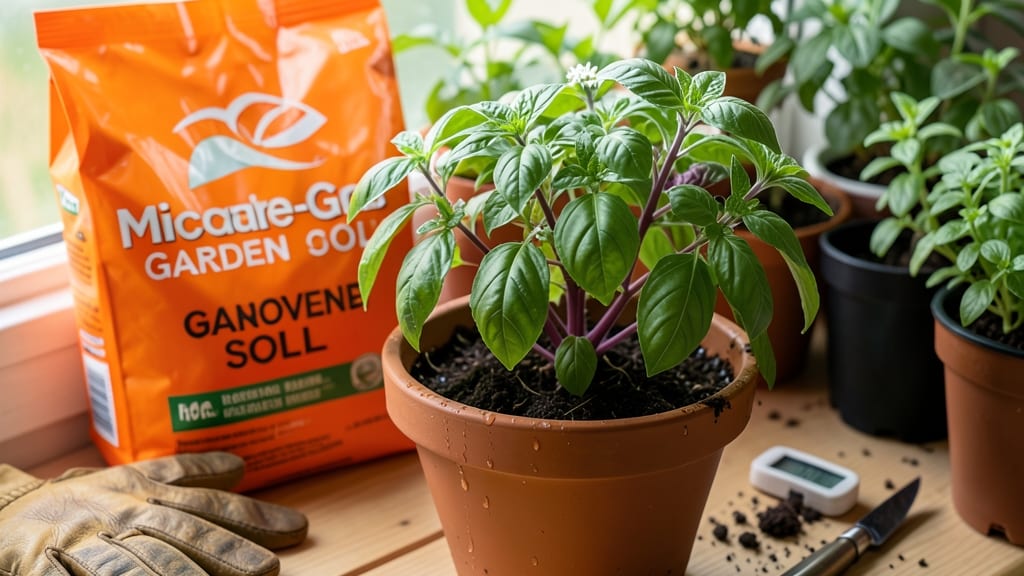
You can use Miracle-Gro Garden Soil in pots, but it needs adjustments: its dense formula holds too much moisture and lacks aeration, so blend it half-and-half with perlite or coarse sand while adding a 1-inch gravel layer at the bottom. This prevents root rot and mimics natural soil structure.
Miracle-Gro Garden Soil works best in-ground where its moisture retention shines, but containers need airflow and drainage. 🌱 The issue? This soil's high clay content compacts easily, trapping water and suffocating roots. I've found that adding perlite (20%) improves aeration while coarse sand (30%) helps break up clumps.
For heavy feeders like tomatoes, I also mix in compost to balance nutrients lost through frequent watering.
Another key factor is container choice: terracotta breathes better than plastic but dries faster, while plastic retains moisture longer. Test your setup by filling a spare pot with the mix, adding water, and checking drainage—if it pools after 10 minutes, add more sand.
This simple test saves plants from soggy soil disasters.
💡 In This Article
- Why Miracle-Gro Garden Soil Needs Modification for Containers
- Step-by-Step Guide: Mixing Miracle-Gro for Potted Plants
Why Miracle-gro garden soil needs modification for containers
Miracle-Gro Garden Soil is formulated for in-ground gardens where its moisture retention and nutrient density excel. However, containers create a fundamentally different environment. The soil's high clay content—typically 30-40%—becomes a liability in pots because clay particles pack tightly when wet, reducing pore space by up to 50%.
This creates an anaerobic zone where roots suffocate from lack of oxygen, a condition plant pathologists call "compaction stress." 🌱 In-ground soil has natural channels from worms and roots, but containers lack this structure.
The problem worsens because containers dry out faster at the edges, creating uneven moisture zones. Without amendments, the center stays soggy while outer layers dry. I've seen basil plants develop root rot in the middle of a pot while the outer leaves appeared thirsty—a classic sign of poor aeration.
The soil's low organic matter content (typically 10-15%) also means it breaks down quickly, losing structure within 3-6 months of use, unlike natural garden soil which maintains porosity for years.
Nutrient availability becomes another issue. Miracle-Gro's fertilizer granules dissolve quickly in moist soil, but containers flush nutrients faster through frequent watering. The high salt concentration from dissolved fertilizers can reach toxic levels in confined spaces.
For example, a 5-gallon pot with straight Miracle-Gro may see salt buildup 3x faster than in-ground planting, stressing sensitive plants like lettuce or petunias.
Here's what happens at the microscopic level: clay particles in Miracle-Gro form tight aggregates that block water movement through capillary action. Without perlite or sand, water pools at the bottom where roots can't access it, while upper layers dry out.
This creates a "bathtub effect" where roots struggle to find equilibrium. 💧 The solution lies in breaking these clay bonds with coarse sand (particle size 0.5-1mm) which creates larger air pockets while perlite adds 90% air space by volume.
Consider this comparison: natural garden soil has a porosity of 45-55%, while unamended Miracle-Gro in pots drops to 25-35%. The difference means roots in containers experience 2x less oxygen availability, similar to breathing through a straw.
This is why even drought-tolerant plants like lavender struggle unless you modify the mix.
One common misconception is that adding more fertilizer will compensate. But in containers, excess salts from fertilizers actually reduce water uptake by creating osmotic pressure against roots. The solution isn't more fertilizer—it's better soil structure that allows roots to access both water and air simultaneously.